


• B.O.S.S.
  • SEED
  • Fellowship
  • Journalism
  • About
  • Contributors
Log in
Impending BloomImpending Bloom

Cultivating change through systems thinking, art, and science.

The Impending Bloom Project is a New York State 501(c)(3) nonprofit organization.

2063 45th St.
Astoria, NY 11105

Programs

B.O.S.S. AcademyS.E.E.D. ProgramGlobal Sustainability FellowshipCitizen Sustainability Journalism

Organization

AboutMeet the FellowsImpactContact

Contact

info@impendingbloom.org

For program inquiries, partnerships,
press, and grant communications.

© 2026 The Impending Bloom Project. All rights reserved.
PrivacyTerms
2026 Spring Sustainability Fellowship · Capstone I

TheDust Cloud
Challenge

A $20 billion semiconductor Mega-Fab location decision. Four layers of systems analysis. One defensible chain of reasoning from narrative to simulation.

Katherine Ross
Katherine RossFellow

Katherine is an Environmental Science student with a background in operations, stakeholder engagement, and data analysis. She brings a cross-sector perspective to sustainability consulting — combining leadership experience with a passion for data-driven climate strategy, ESG, and sustainable operations.

Ella Lau
Ella LauFellow
Panelist Adjudicators
Rebecca Niles
Rebecca NilesExecutive Director, System Dynamics Society

With 30 years of cross-sector leadership spanning health, real estate, energy, education, and public policy, Rebecca is a certified Systems Dynamics facilitator trained in the methodology developed at MIT Sloan School. She holds an MBA and engineering degree, and has facilitated strategy engagements across Morocco, Brazil, Nigeria, Portugal, the United Kingdom, and New Zealand.

LinkedIn
Jesse Herstein
Jesse HersteinDirector, Sustainability & ESG — BDO

Director of Sustainability & ESG Strategy and Operations at BDO, Jesse leads client services spanning ESG strategy, reporting compliance, decarbonization, and project finance. His roots are in communications and storytelling — applied to brand positioning and sustainability reputation management across corporate and consulting organizations locally and globally.

LinkedIn
Project Overview

The Silicon-Water Nexus

From Location to System

The Dust Cloud Challenge began as a location problem: which of two candidate sites — Phoenix, Arizona or Ho Chi Minh City, Vietnam — should a leading semiconductor manufacturer choose for a $20-billion EUV-class mega-fabrication facility? That question quickly became a systems problem. What began as a comparison of permits and subsidies evolved into an investigation of how a single industrial installation restructures water rights, energy grids, community contracts, and long-range climate exposure across a thirty-year operating horizon.

The scale of the object under analysis is worth establishing. A mega-fab using extreme ultraviolet lithography — modeled here on TSMC Fab 21, currently the largest foreign direct investment in U.S. history — draws 5–10 million gallons of ultra-pure water per day, consumes 100–500 megawatts of electricity, and relies on nitrogen trifluoride for chip etching: a gas with a global warming potential 17,200 times that of carbon dioxide. The constraints are not incidental to the location decision. They are the analysis.

Between the two candidate sites, each failure mode was distinct. Vietnam offered lower labor costs and an emerging tech ecosystem, but a coal-dependent grid responsible for $1.4 billion in blackout losses in a single year and a coastline projected to face threefold flood depth increases by 2050. Arizona offered political stability and $52.7 billion in CHIPS Act subsidies, but a Colorado River at Tier 1 shortage and structural drought entering its second decade. The team chose Arizona — not because it was the obvious answer, but because it was the harder case: real constraints, granular data, and a genuine question of thirty-year viability.

What unfolds across the four diagrams is a silicon–water nexus: a tightly-coupled feedback architecture linking GRI 303 (Water), GRI 413 (Local Communities), and GRI 201 (Economic Performance). Each layer translates the same system into a more rigorous form — qualitative loops become discrete states, states become parametric equations, and equations become inputs for autonomous decision agents. The result is a single defensible chain of reasoning from narrative to simulation.

The decision in numbers
~8.9M gal/day
Ultra-pure water demand per fab — roughly 3% of Phoenix’s total municipal supply
100–500 MW
Daily power draw per facility — equivalent to the full load of a small city
$52.7B
CHIPS Act subsidy ceiling — Arizona’s decisive financial advantage over Vietnam
Tier 1
Colorado River shortage status — structural drought entering its second decade
$1.4B
Vietnam grid blackout losses in a single year — World Bank, 2023
The MBSE Stack — How the layers fit together

From narrative reasoning to simulated governance

Each layer below corresponds to one section of this page. They are read top-to-bottom: the CLD surfaces the feedback dynamics, the state machine sequences regime transitions, the parametric diagram quantifies the equations, and the multi-agent simulator demonstrates how those equations could be governed in real time.

LAYER 01
Causal Loop Diagram
Maps reinforcing and balancing feedback across the three GRI pillars.
LAYER 02
State Machine
Sequences the five operational regimes the CLD implies but cannot order.
LAYER 03
Parametric Diagram
Quantifies state transitions with the five constraint blocks driving the model.
LAYER 04
Multi-Agent System
Externalizes governance across five specialized AI agents and a review board.

01 / CAUSAL LOOP DIAGRAM

The Silicon–Water Nexus

The qualitative entry point. Twelve system variables and six feedback loops — two reinforcing spirals (R1 Water Scarcity, R2 Social License Erosion) and four balancing loops (B1 Technology Pivot, B2 Federal Subsidy Buffer, B3 Energy Constraint, B4 Renewable Energy Buffer) — mapped across GRI 300s, 400s, and 200s with an Iceberg Model overlay surfacing events, patterns, structures, and mental models.

12 Variables6 Loops3 GRI PillarsIceberg Overlay
dust_cloud_cld_v2.html · Interactive
Open ↗

02 / STATE MACHINE DIAGRAM

Five regimes, one absorbing endpoint

The CLD tells us what feeds back into what; the state machine tells us in what order. Five operational regimes — Stable, Stressed, Non-Compliant, In Recovery, Terminal — connected by guarded transitions tied directly to the parametric model’s constraint thresholds. The Terminal state has no exit arrow: once CHIPS disbursement falls below the 5% floor, the model treats it as absorbing.

5 StatesGuarded TransitionsSysMLAbsorbing Terminal
state_machine_diagram.html · Interactive
Open ↗

03 / PARAMETRIC DIAGRAM

The mathematical core

Five interdependent subsystems — Water, Energy, Production, Community, Economic — linked by constraint equations. WaterBalance and WaterStressIndex map to GRI 303; CommunityResistance and PermitRisk map to GRI 413; CHIPSFunding maps to GRI 201. Drag the sliders to see how a water-withdrawal increase cascades through community resistance into permit risk and CHIPS disbursement.
5 SubsystemsConstraint EquationsLive SlidersScenario Presets
dust_cloud_parametric.html · Interactive
Open ↗
Computational Optimization · NSGA-II Pareto Analysis

The Goldilocks Zone

The parametric diagram lets you explore individual slider positions. These charts answer a harder question computationally: across the full decision space, is there a genuine trade-off between chip production and sustainability — or can both be maximized simultaneously? Using NSGA-II, a multi-objective evolutionary algorithm, 200 candidate operating configurations were optimized across 300 generations under three water-availability scenarios, revealing a system structure that challenges conventional assumptions about the cost of environmental responsibility.

Chart 1 of 3

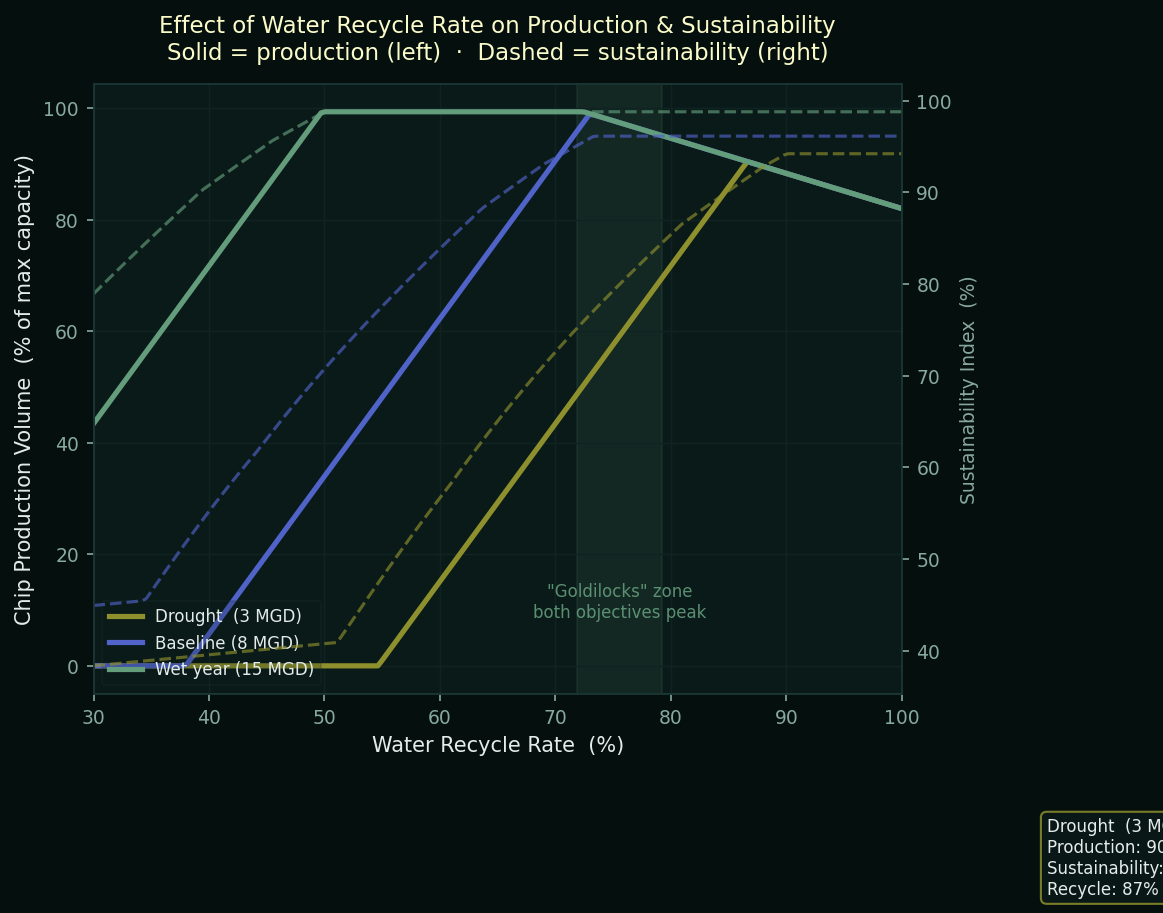
Production & Sustainability Across the Recycle Rate Spectrum

Sensitivity sweep: chip production volume and sustainability index plotted against water recycle rate for drought, baseline, and wet-year scenarios.

Each solid line traces chip production volume (left axis) as the water recycle rate rises from 30% to 100%; dashed lines trace the sustainability index (right axis) for the same sweep. Both objectives move together — below the minimum recycle threshold, aquifer depletion collapses them simultaneously; above it, both plateau in the Goldilocks zone. There is no region where sacrificing one meaningfully gains the other. The three lines show how drought (olive), baseline (blue), and wet-year (teal) scenarios shift the shape and position of that zone.

Chart 2 of 3

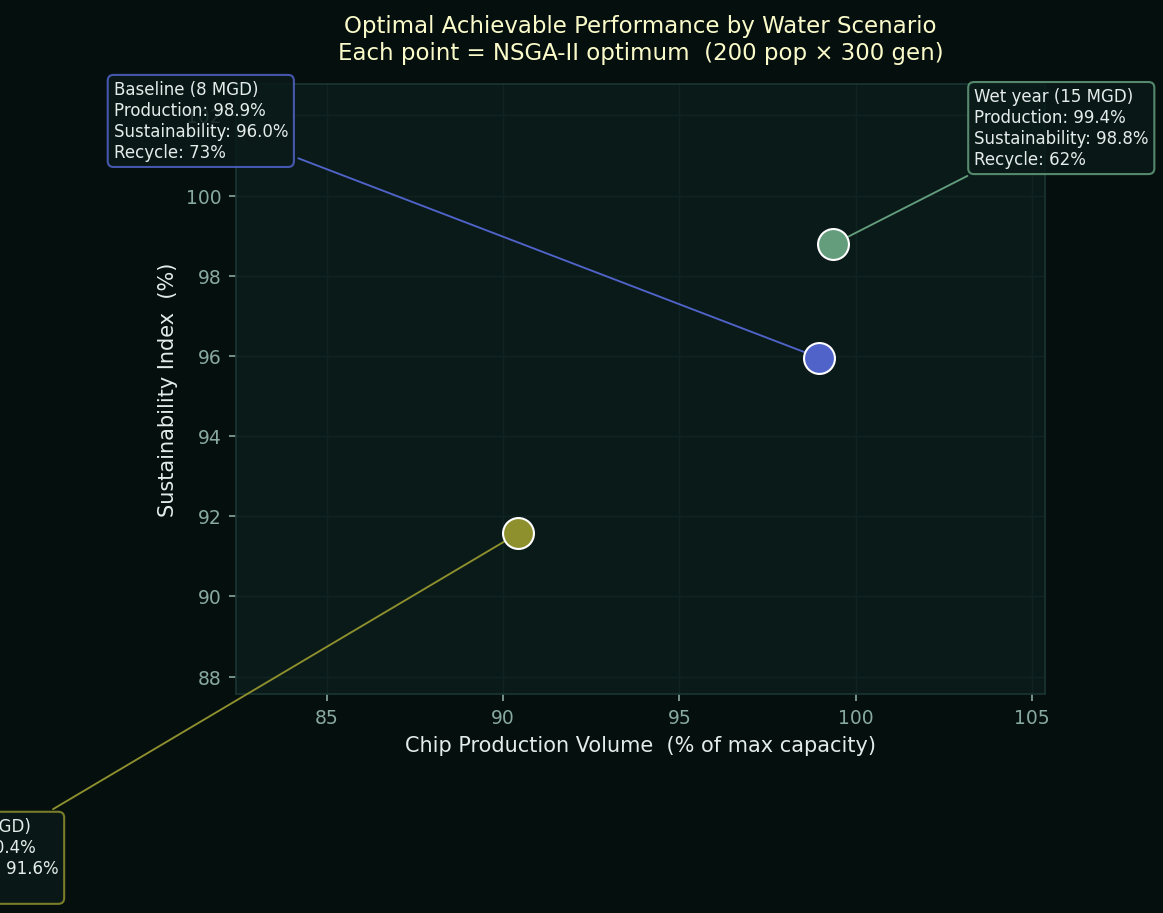
What Water Scarcity Costs — Optimal Performance by Scenario

Scatter plot: three NSGA-II optimal points, one per water scenario, showing drought isolated at lower production and sustainability versus baseline and wet year.

Each point is the NSGA-II optimum for its water scenario — the best simultaneously achievable production and sustainability across 300 generations of search. The gap between Drought (lower-left) and Baseline/Wet Year (upper-right) is the model's quantified answer to the Arizona siting question: structural water scarcity costs approximately 11 percentage points of production capacity and 2 points of sustainability index. Any 30-year operating plan must account for Arizona's recharge rate declining toward the drought scenario as the Colorado River compact deteriorates.

Chart 3 of 3

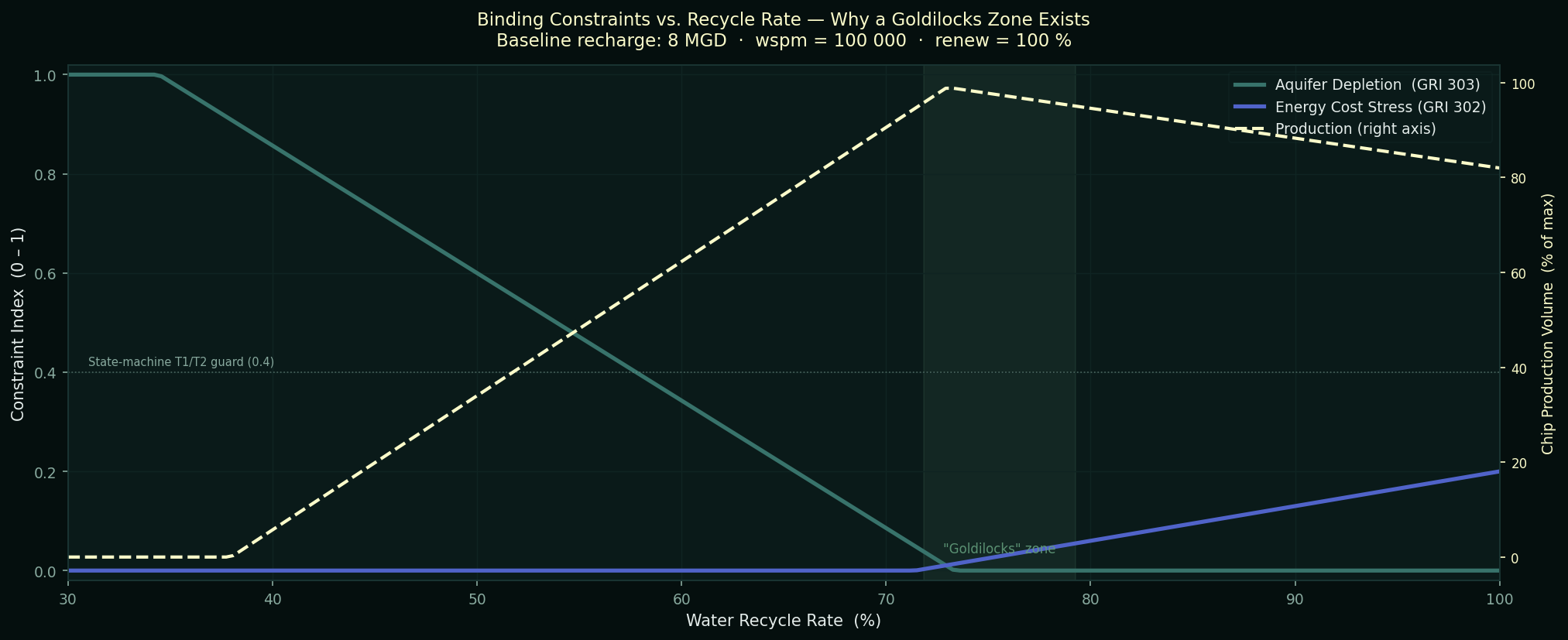
Why the Goldilocks Zone Exists — The Binding Constraint Crossover

Aquifer depletion falling and energy cost stress rising as recycle rate increases, with chip production peaking in the notch between them.

Two constraints run in opposing directions. Aquifer Depletion (teal) falls as recycling rises — less net withdrawal from the stressed aquifer. Energy Cost Stress (blue) rises — semiconductor-grade UPW treatment is energy-intensive at scale and builds faster than 100% renewable adoption can offset. Chip production (dashed cream) peaks precisely in the notch where both constraints are near their minimum, just above the state-machine T1/T2 guard threshold of 0.4. The optimal operating point is not a choice — it is a physical property of the system, sitting at approximately 73–79% water recycling with 100% renewable energy adoption.